FIT PROTOCOL · Door 1 · Start Here The system behind the goal. A personal record of food, drink recipes, training and recovery — with explanations of what each part contributes.
Pause motion Ⅱ ☰ Overview sections ▾
Start here
Choose your starting point
PROJECT 100 The journey.
FIT PROTOCOL Ingredients · Training choices · Measurements behind the journey. New here? Baseline → Fixes
Start with the goal and baseline. Begin with the goals and baseline Explore the daily routine, food and training. Check how results are measured. Understand the terms ⌄
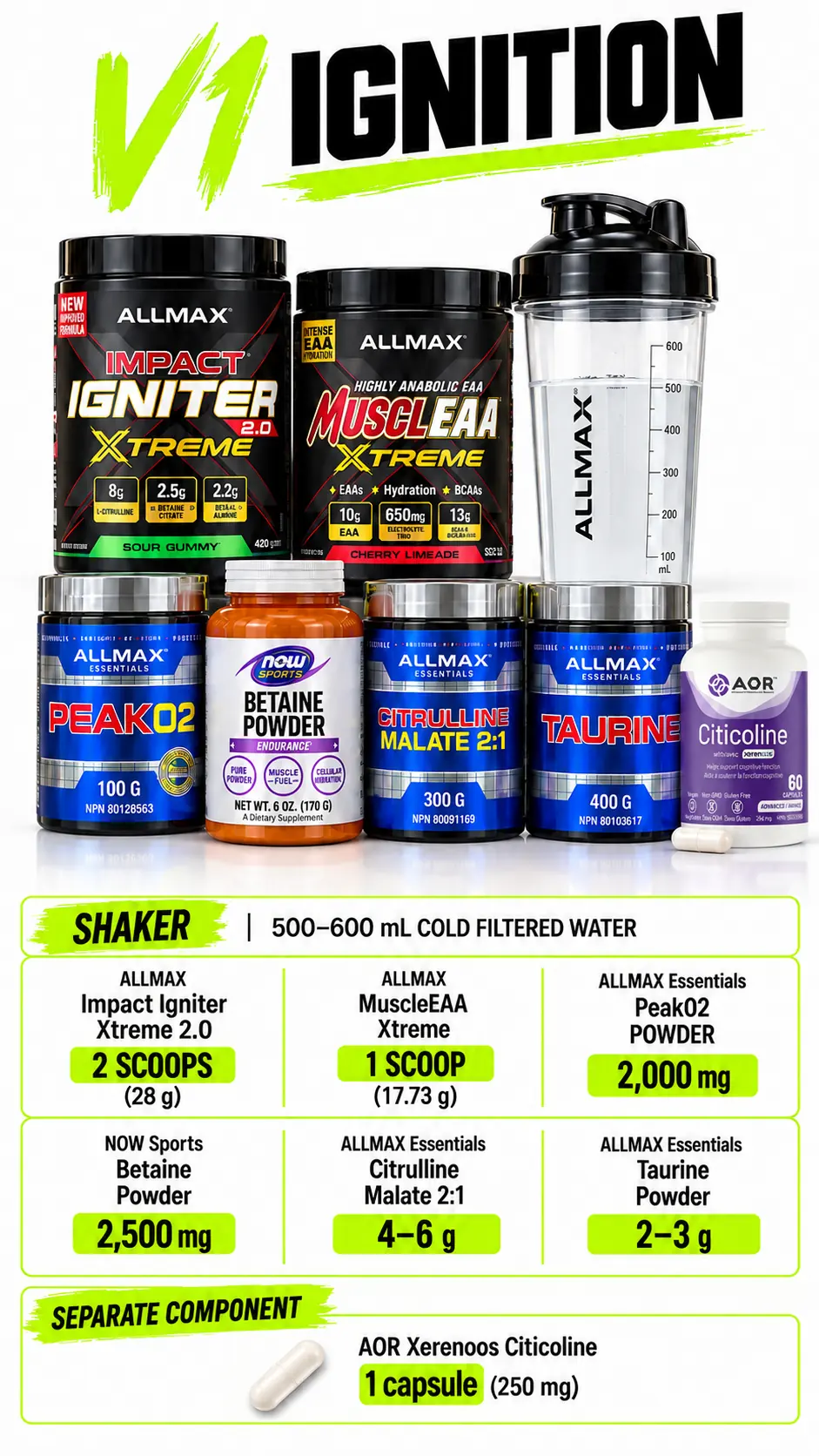
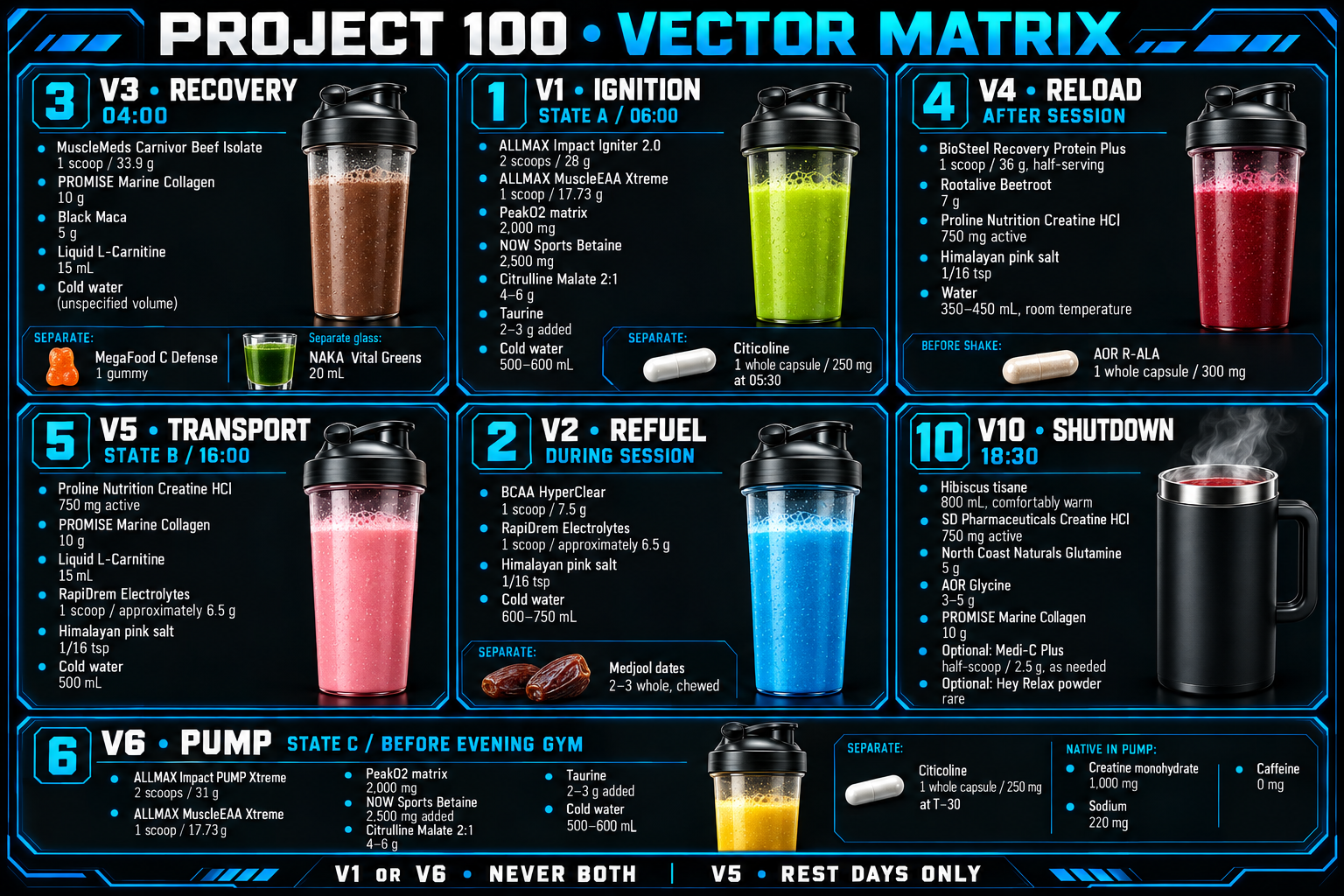
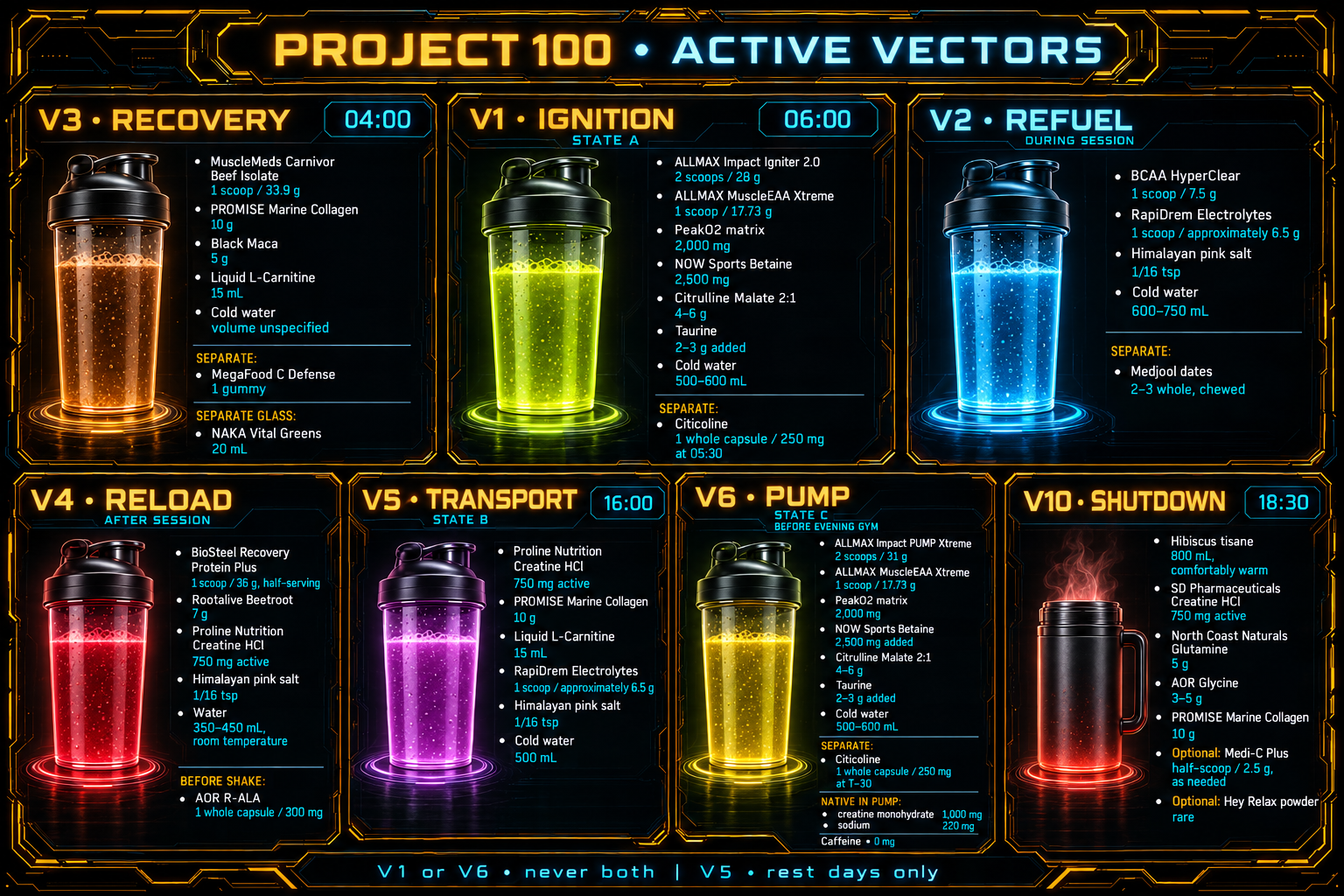
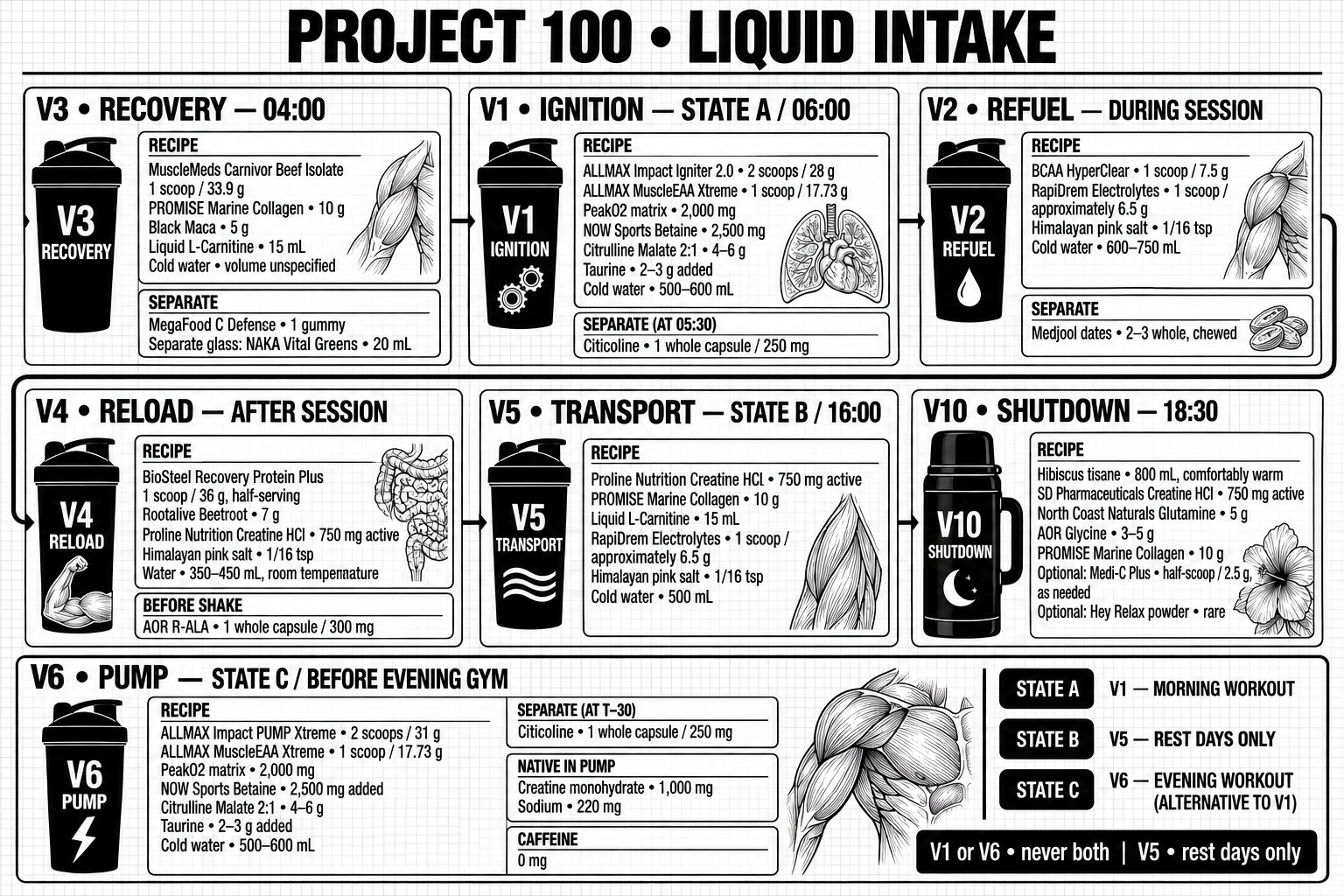
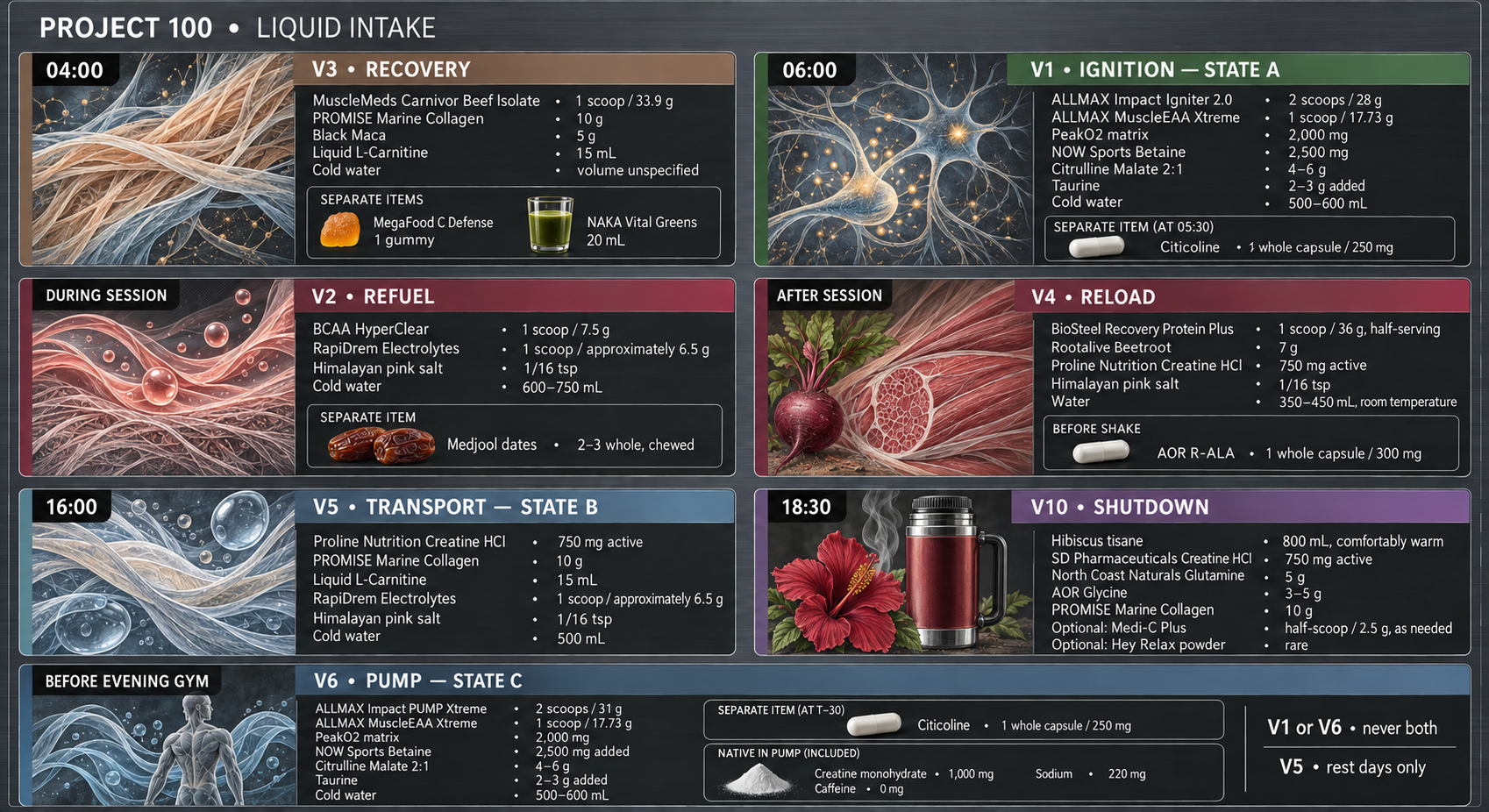
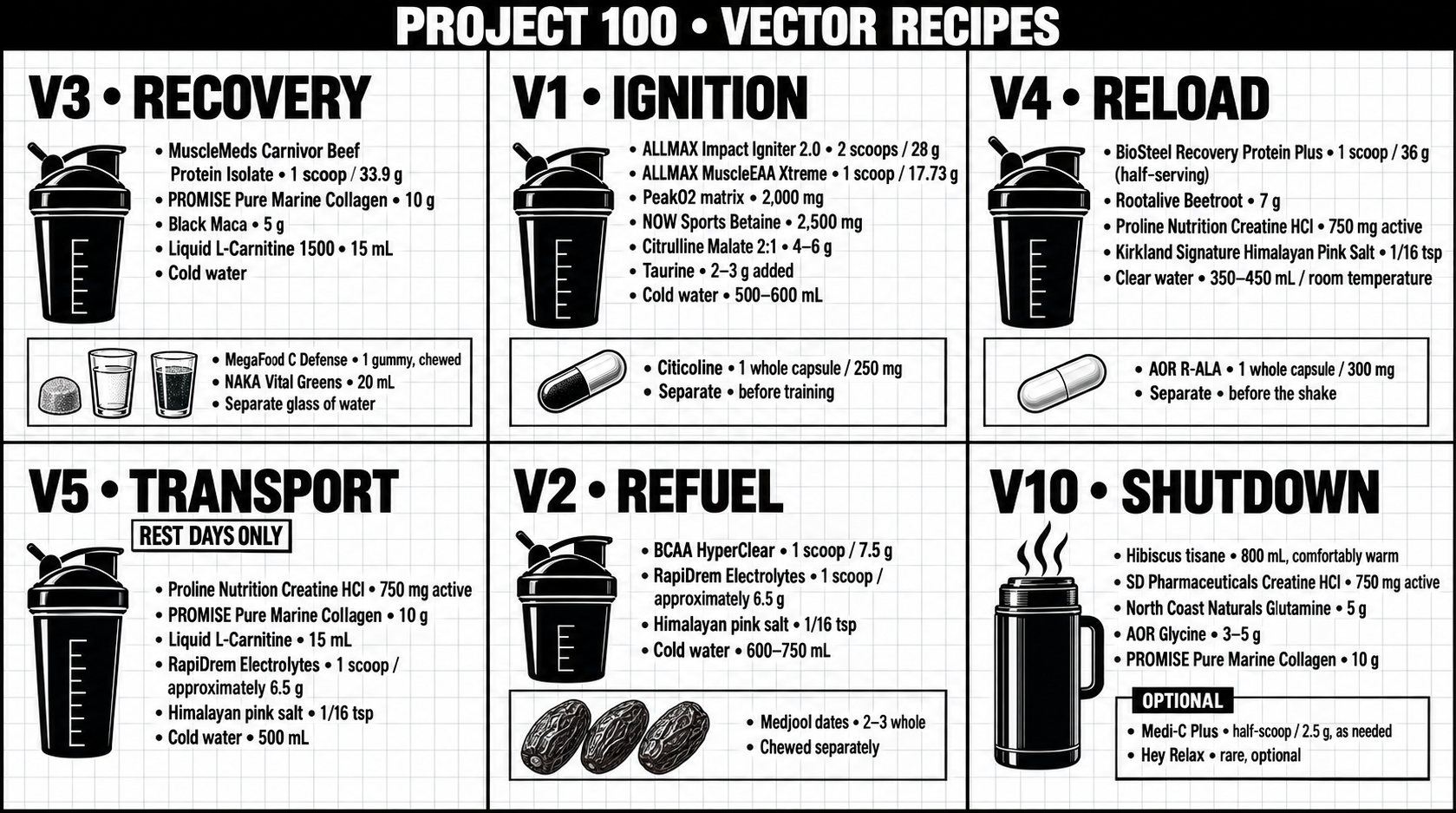
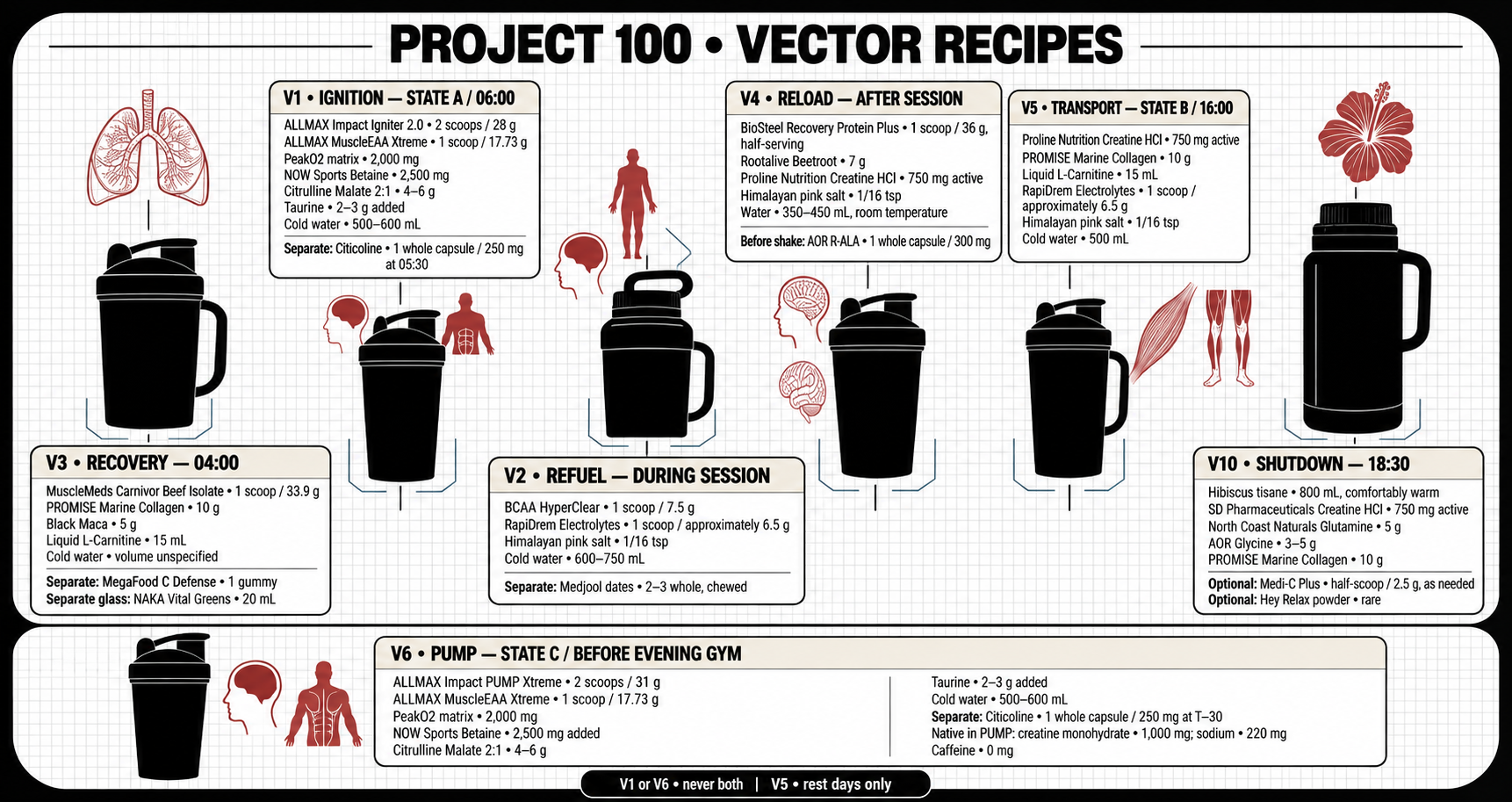
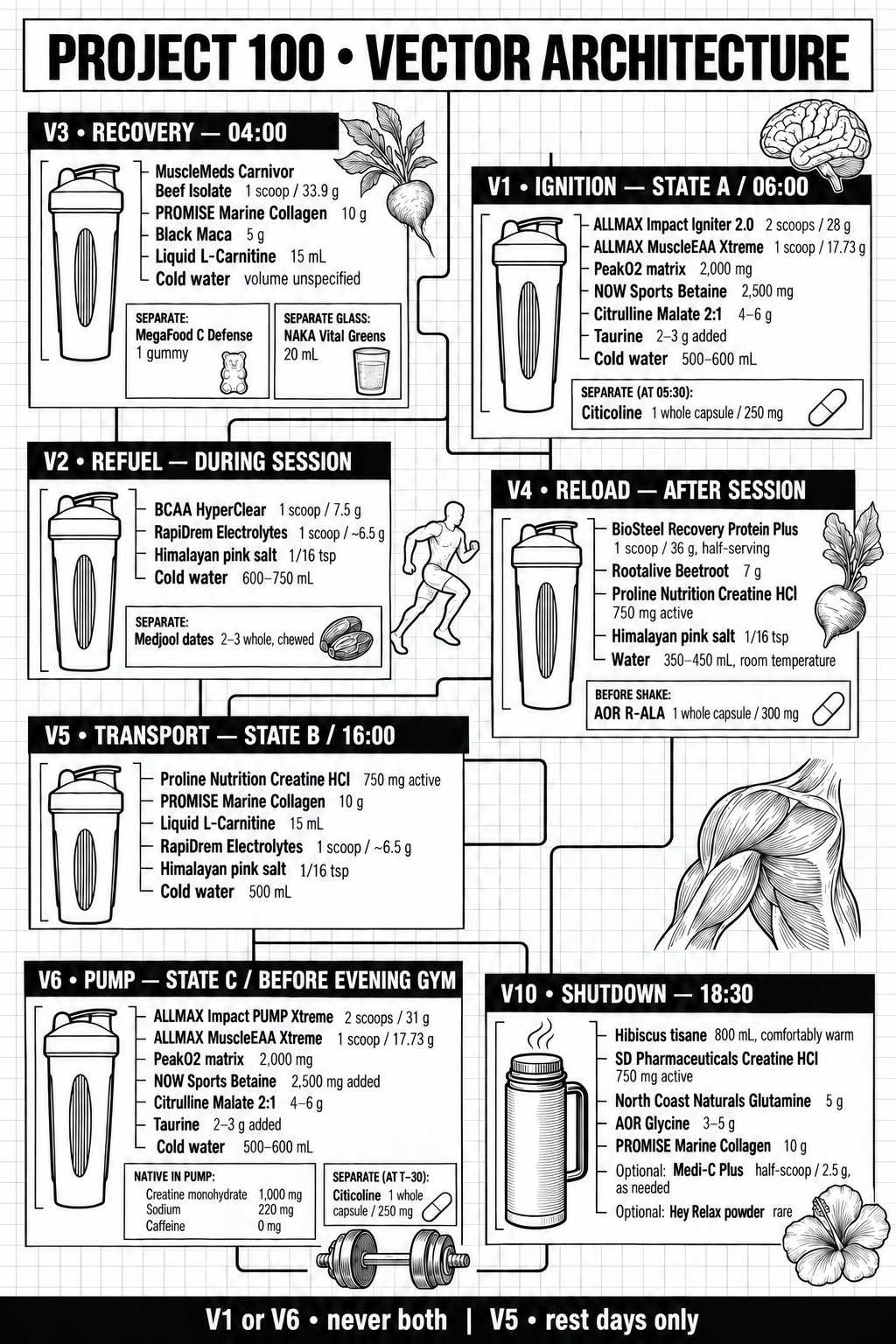
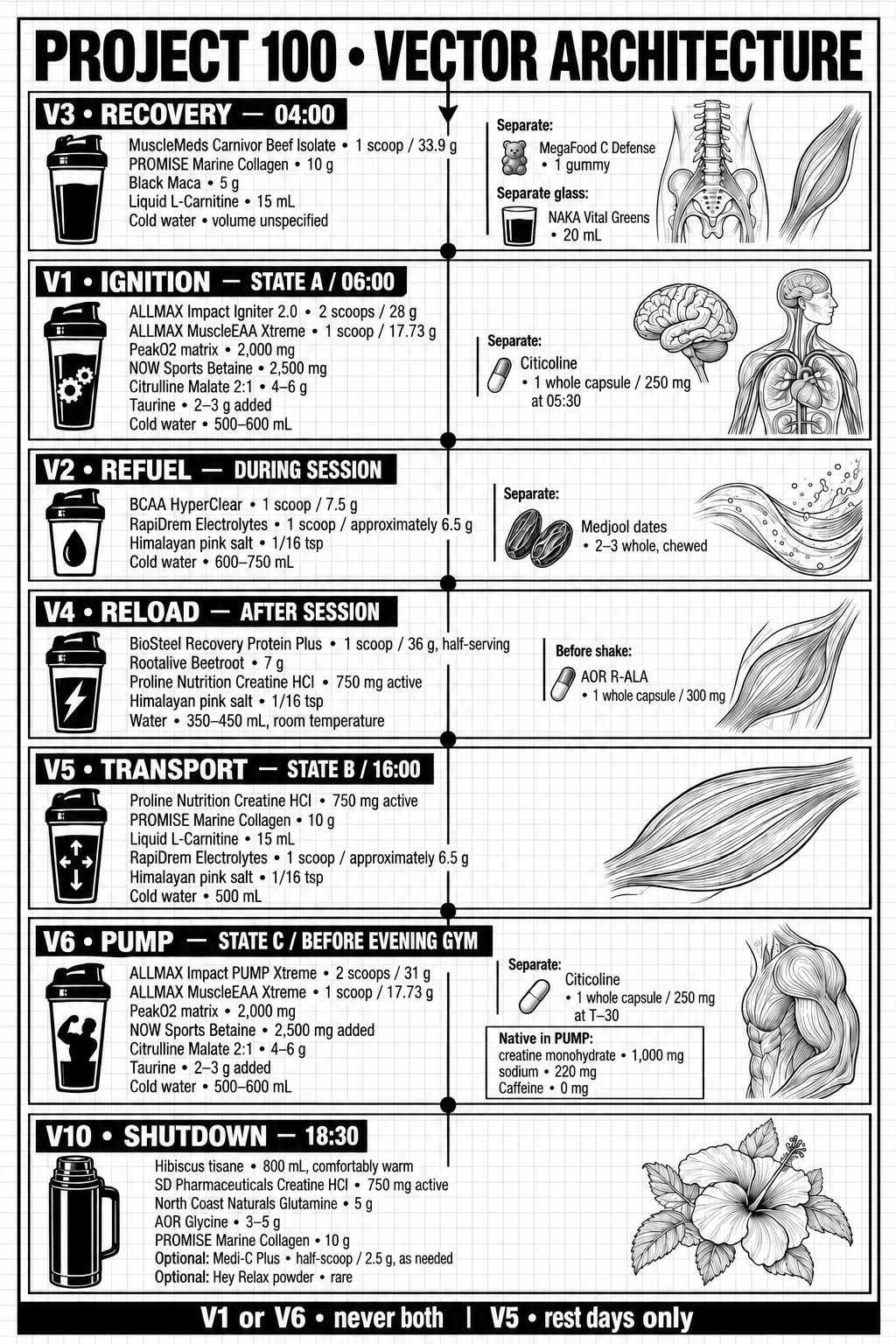
Vector A named drink recipe, such as V1 or V4. Its card explains the ingredients and its place in the day.
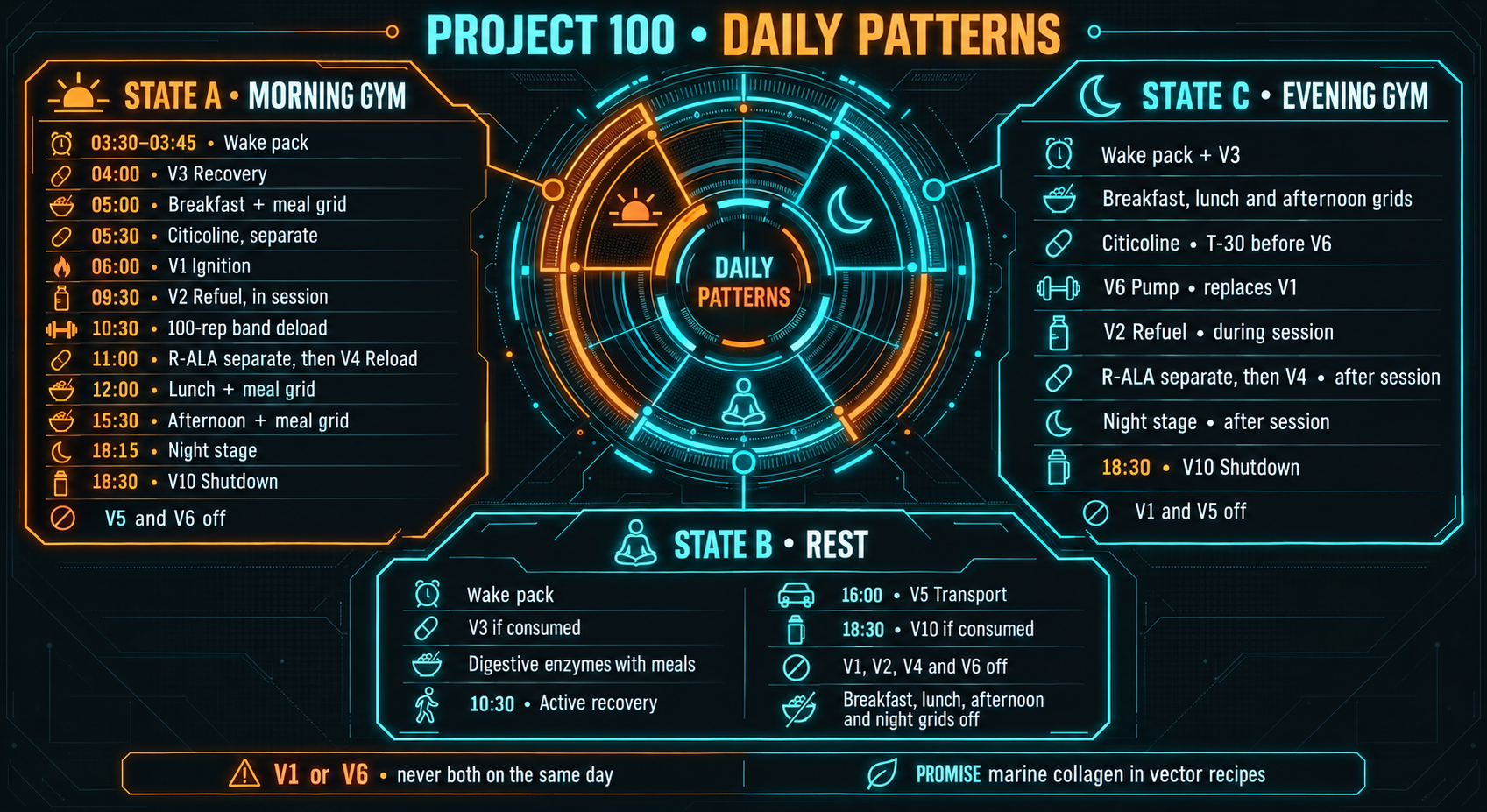
States A, B and C A means morning training; B means a rest day; C means evening training.
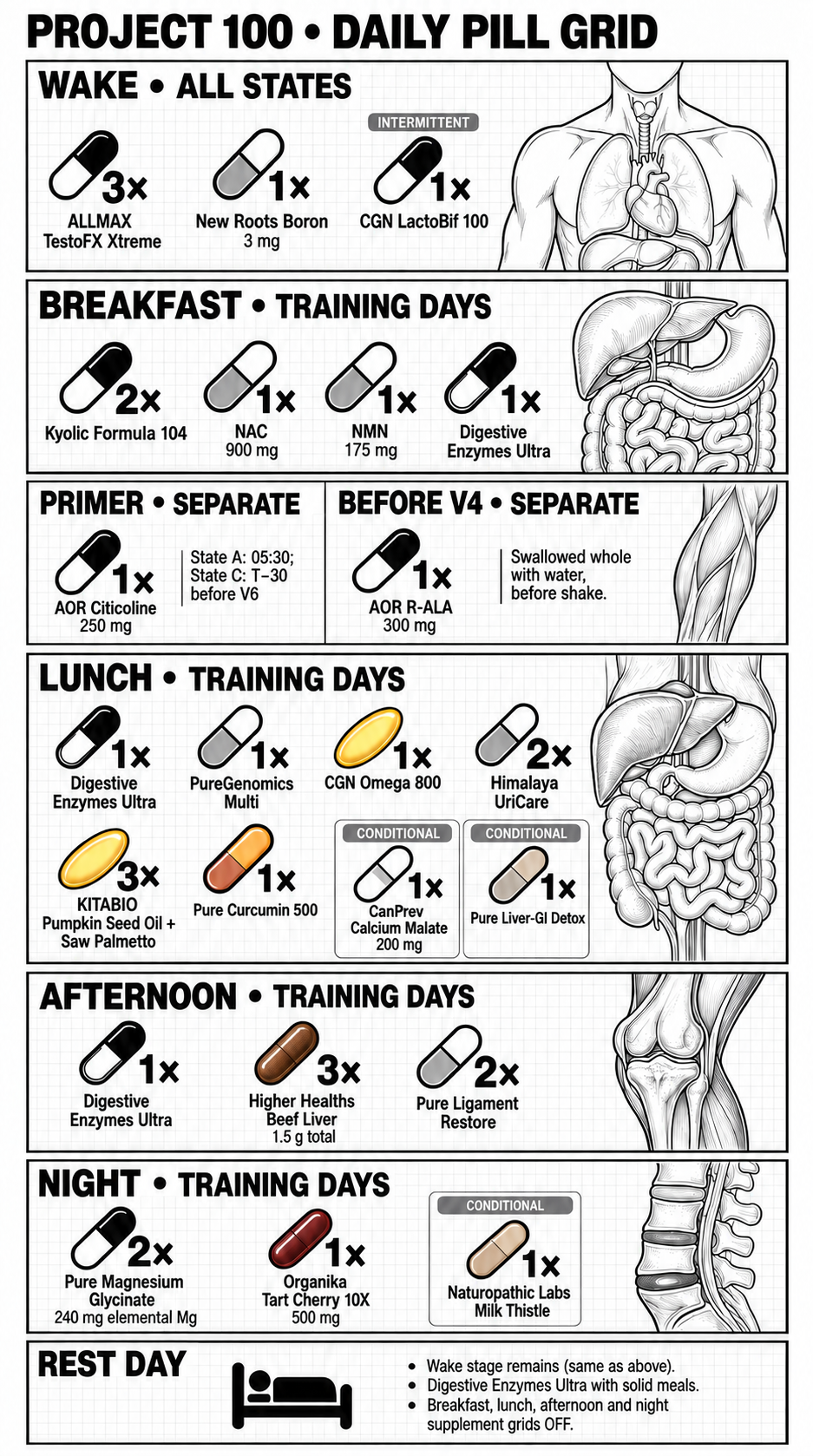
DMZ The label used for the midday meal and capsule group. It identifies an organizational block in the personal schedule.
Hardware lock A symptom or physical constraint that limits exercise choice, range or load.
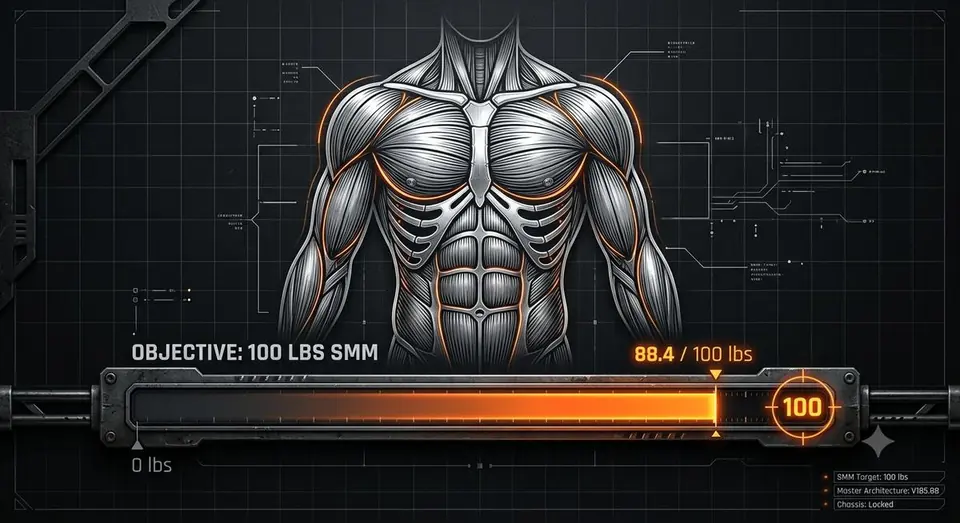
SMM and BIA SMM is skeletal muscle mass. BIA is the water-sensitive body-composition measurement used for the recorded estimates.
ON THIS PAGE
Folder 01
Vector registry · 5 October 2026
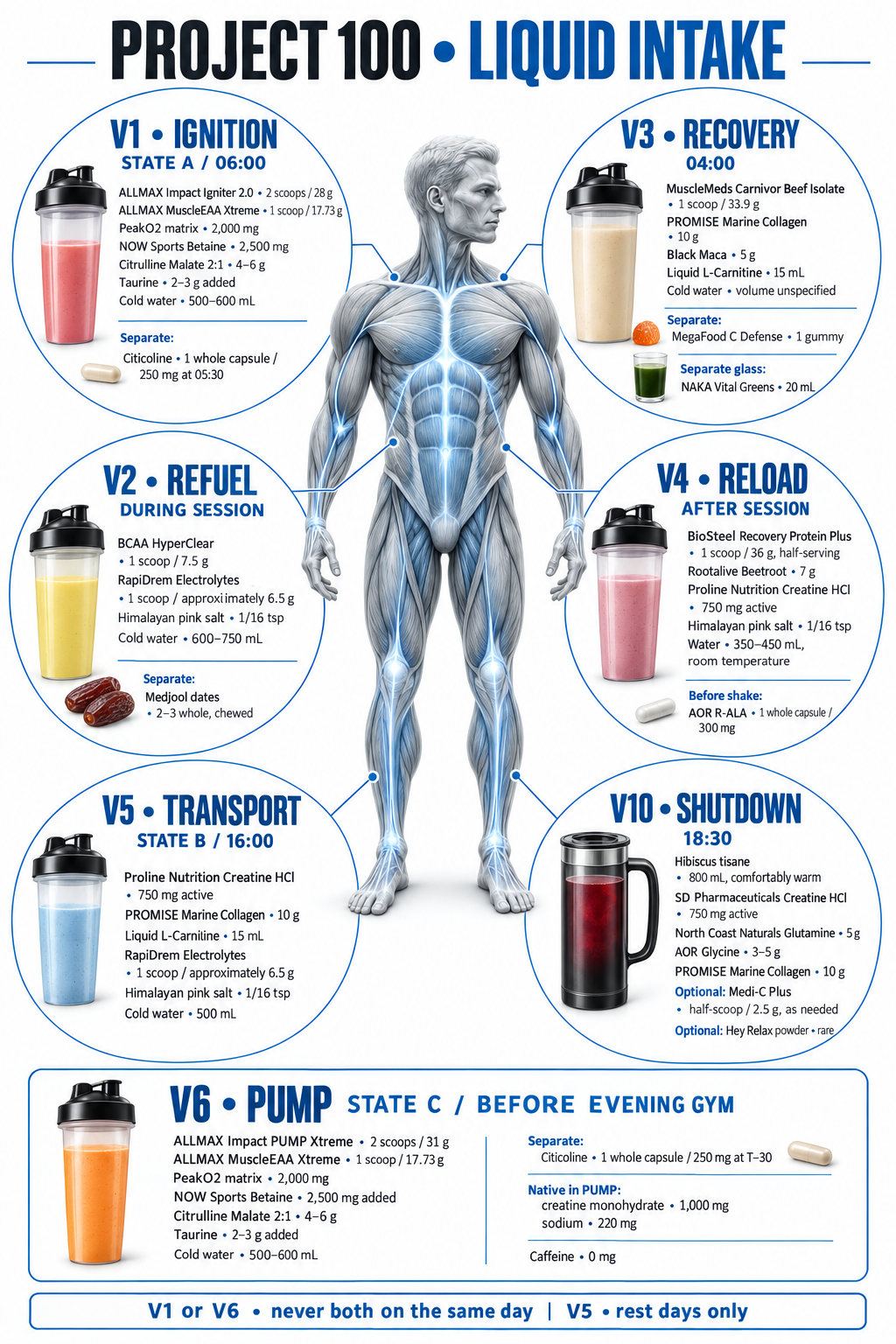
Morning: V3, V1, V2, V4, V10. Rest: V3 when consumed, V5, V10.
Evening override: V3, V6, V2 during the session, V4 afterward, V10 at night. V1 and V6 are never combined on the same calendar day; both are inactive on rest days. V7–V9 have no supplied records.
V6 is the evening-training option. It replaces the older unnumbered PUMP label; artwork may still say PUMP. V1 and V6 remain alternatives for different training branches.
Folder 02
Daily guide notes 2 cards · tap to open
Daily guide notes
How to use the current Guidebook V3.7 ‹ › ×
How to use the current Guidebook V3.7
What stayed locked (Protocol reference corrections): Zinc Supreme removedSeparate copper paused Boron locked at 1 x 3 mg V4 fixed at half the BioSteel serving RapiDrem replaces BioSteel Hydration in V2 and V5 Canadian Carnivor credited with zero added creatine V10 heating mandate retired V6 PUMP now has a separate evening-training branch (5 October 2026) THE V3.2 ANALYSIS PATTERN (USED IN EVERY CHAPTER)
Daily schedule
Lens Question it answers
Mechanism How does this actually work in the body? Stack interaction What does it amplify or collide with elsewhere in the system? Margin How close are you to the known upper limit or symptom threshold? Monitor What do you watch, test, or log to stay safe? Stop rule What symptom or result pauses or removes it?
Important: This book documents your personal system. It is not medical advice and does not replace your clinician.
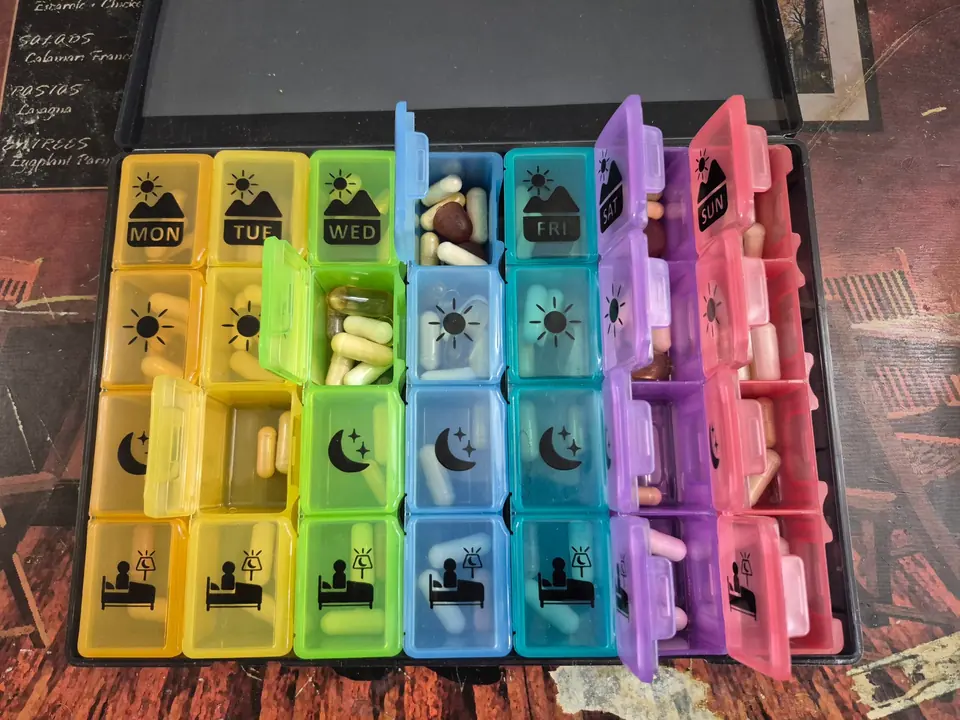
Any change to prescription medication, or any new symptom, goes to a clinician first. Bring this book to appointments — especially the pill grid and lab pages.
Known totals are partial label calculations, not a measured whole diet; whole-diet verification remains deferred, and the historical 2,780 kcal / 252 g protein / 69 g fat figures are legacy planning figures only. Source:
Further study: Training evidence & interpreting the recorded plan →
Daily guide notes
The System: INTAKE x VECTOR x TIME ‹ › ×
The System: INTAKE x VECTOR x TIME
Everything in Project 100 reduces to one equation. Intake is what you take in (food, pills, nutrient products).
Vector is the directed protocol that delivers it (V1–V10). Time is when it happens — and time is where most systems fail, because a good dose at the wrong hour becomes a bad dose.
Daily schedule
Training day Rest day
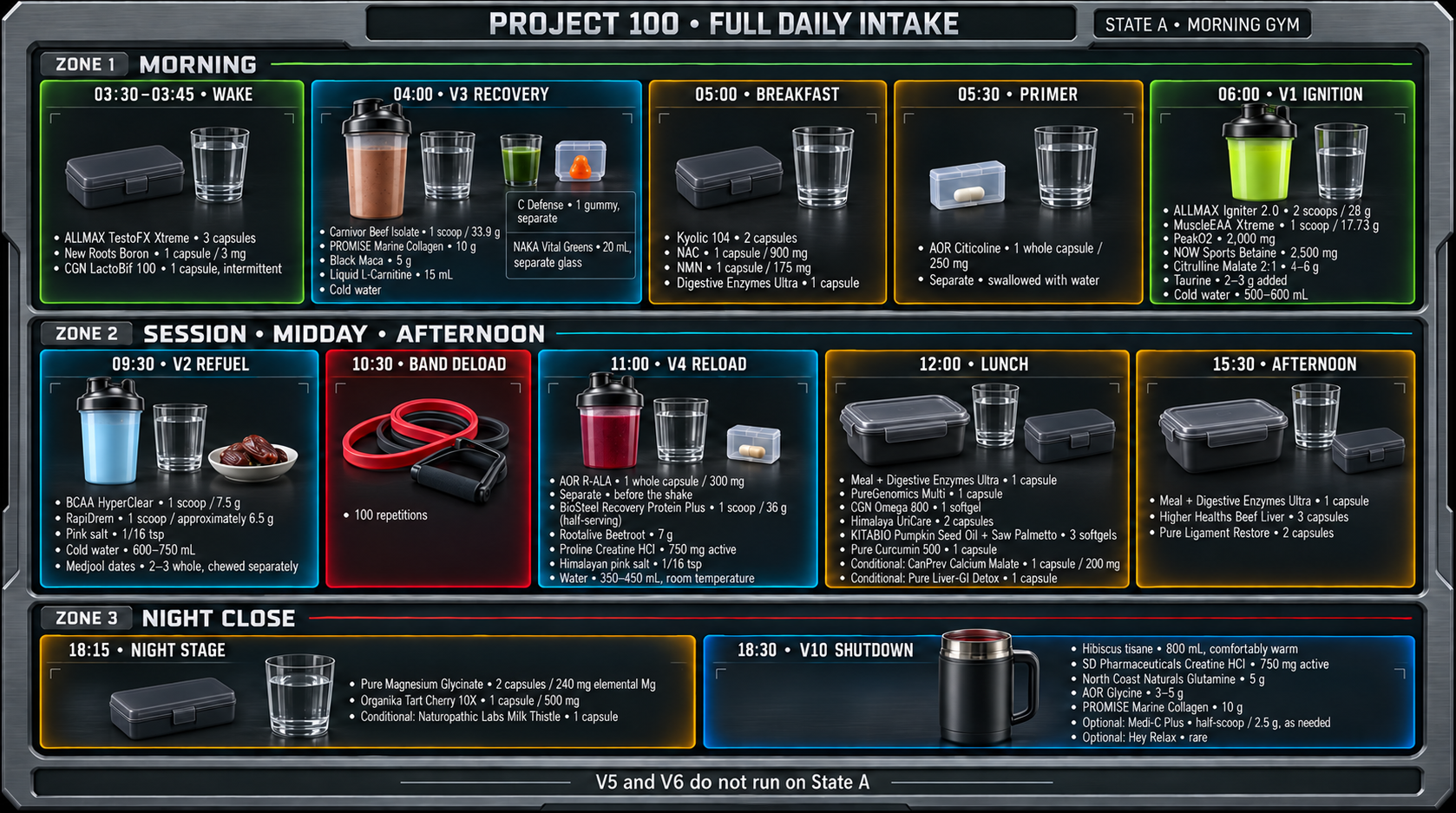
Priority Performance + recovery Repair + tolerance reset Active vectors V1, V2, V3, V4, V10 — timed to the session V3 (when consumed), V5 (if consumed), V10 Pill grids Full training grids at lunch and afternoon Training pill grids skipped V6 PUMP Inactive on morning/rest days; State C evening override replaces V1. Inactive on morning/rest days; State C evening override replaces V1. Nutrition & Meals Higher energy, timed protein Protein held, energy moderated Progress Monitoring RPE, HR, session completion Sleep, HRV, gut, mood
Analysis lens: Most nutrient product risk is not dose risk — it is stacking at the same hour. The V3.2 reference therefore analyses every protocol twice: alone, and as stacked.
The stacked analysis is the one that governs.
Further study: Training evidence & interpreting the recorded plan →
Illustrated
Illustrated guides
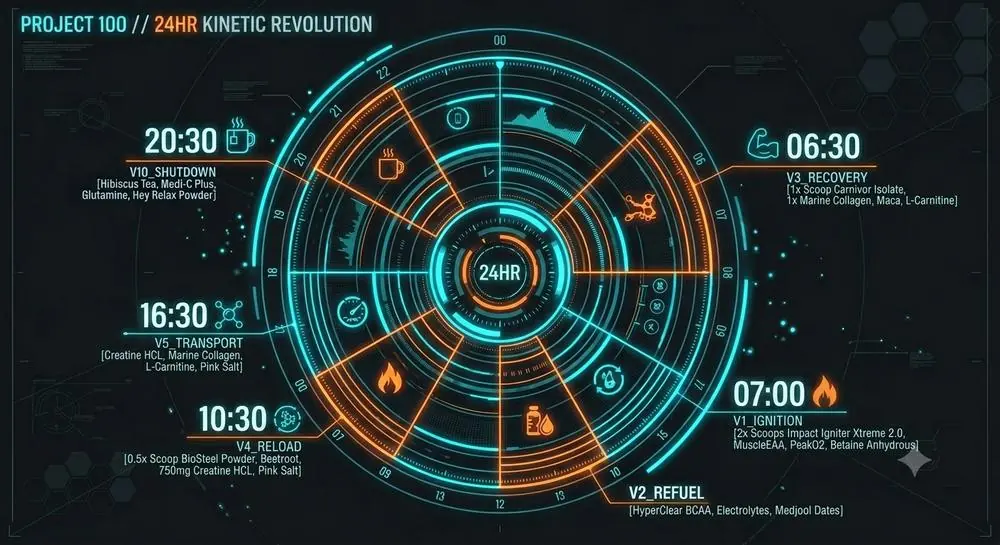
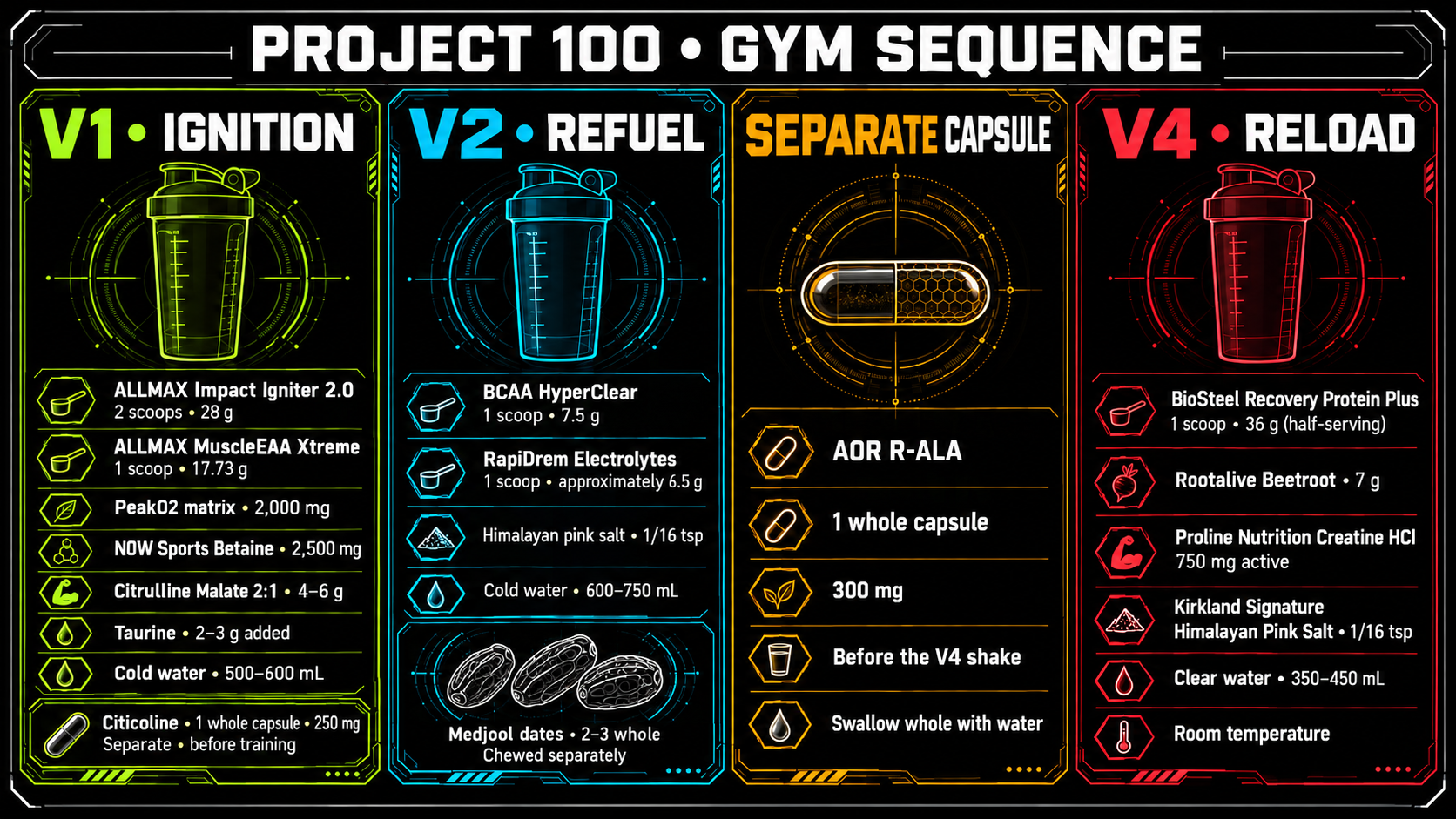
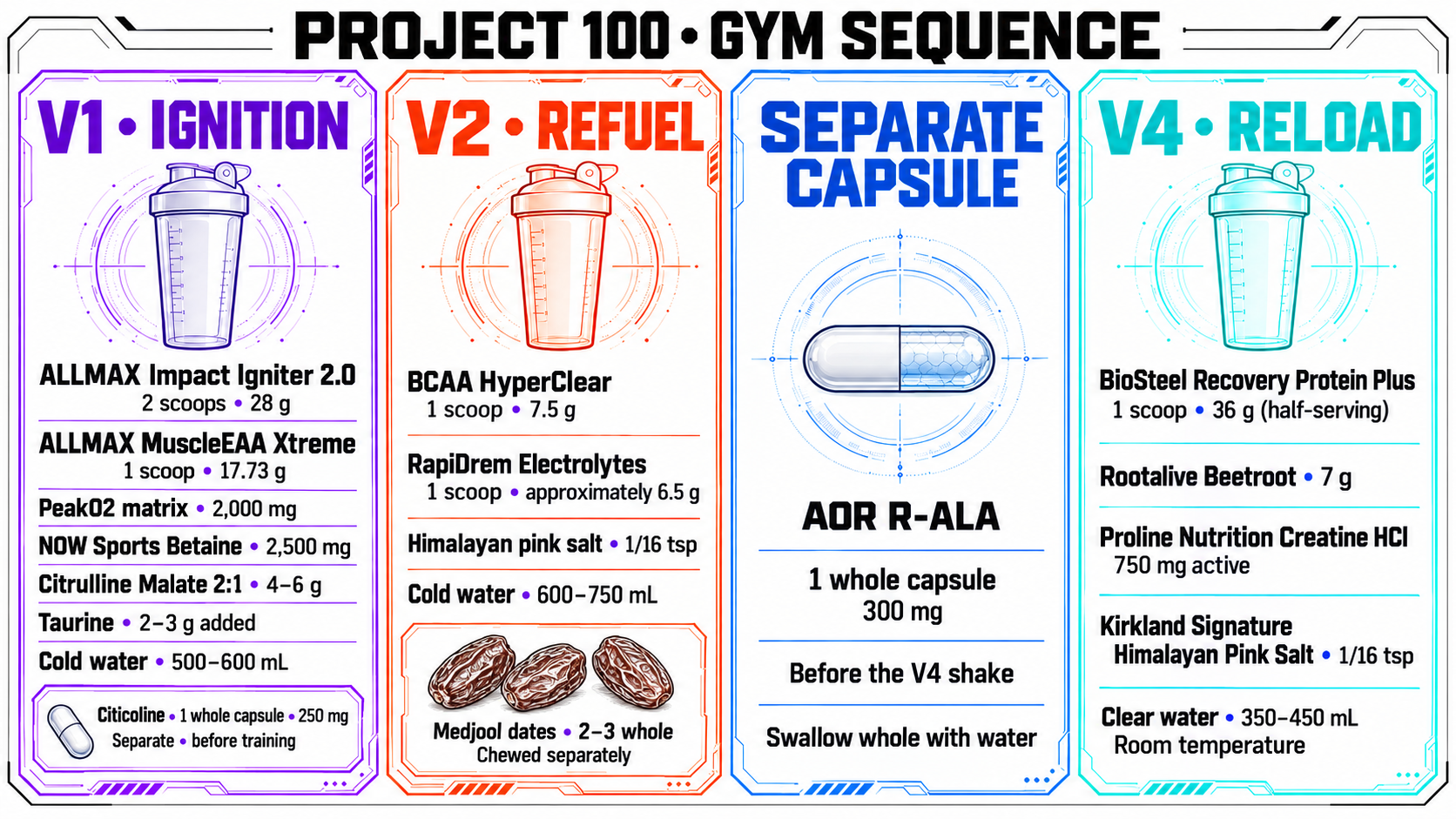
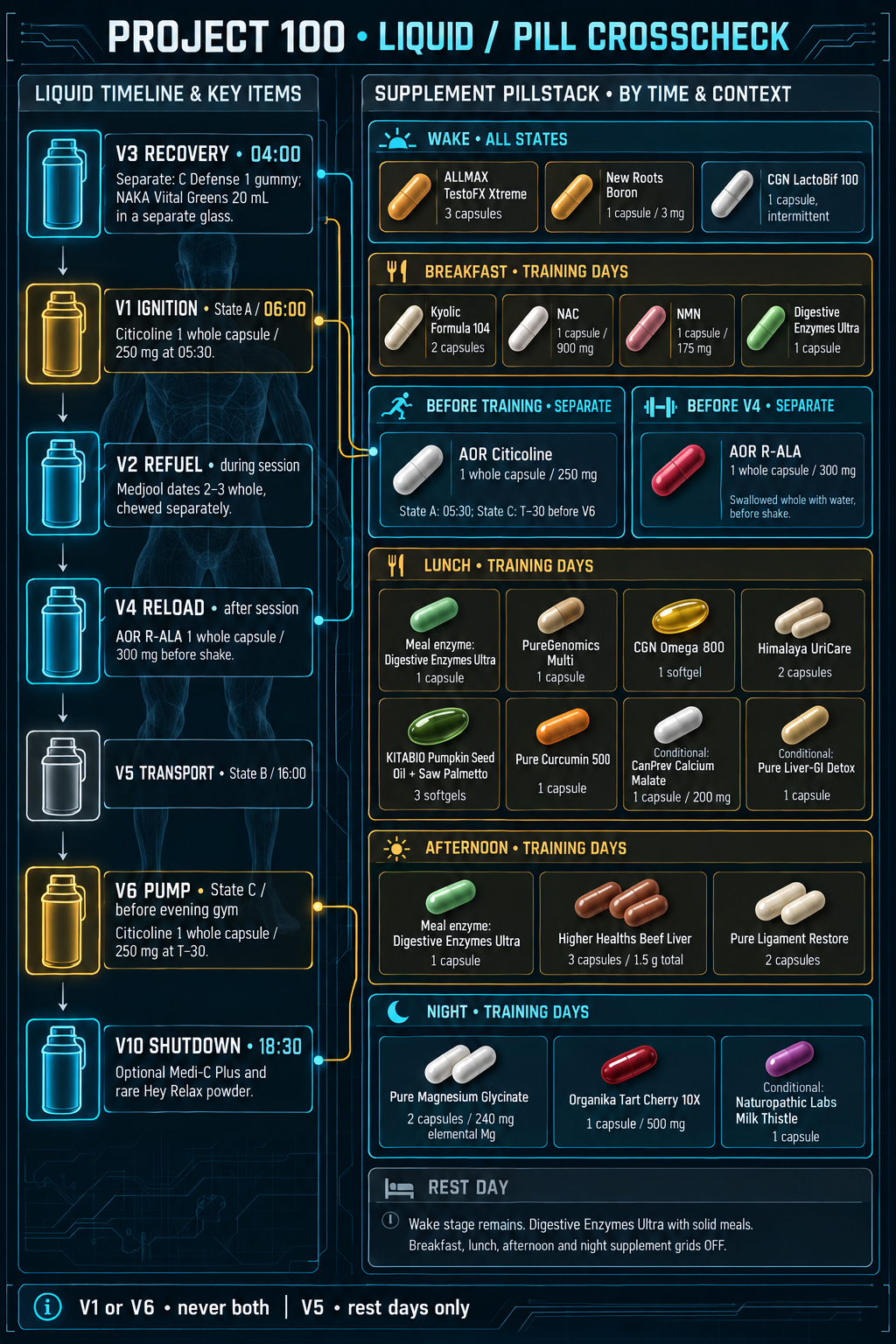
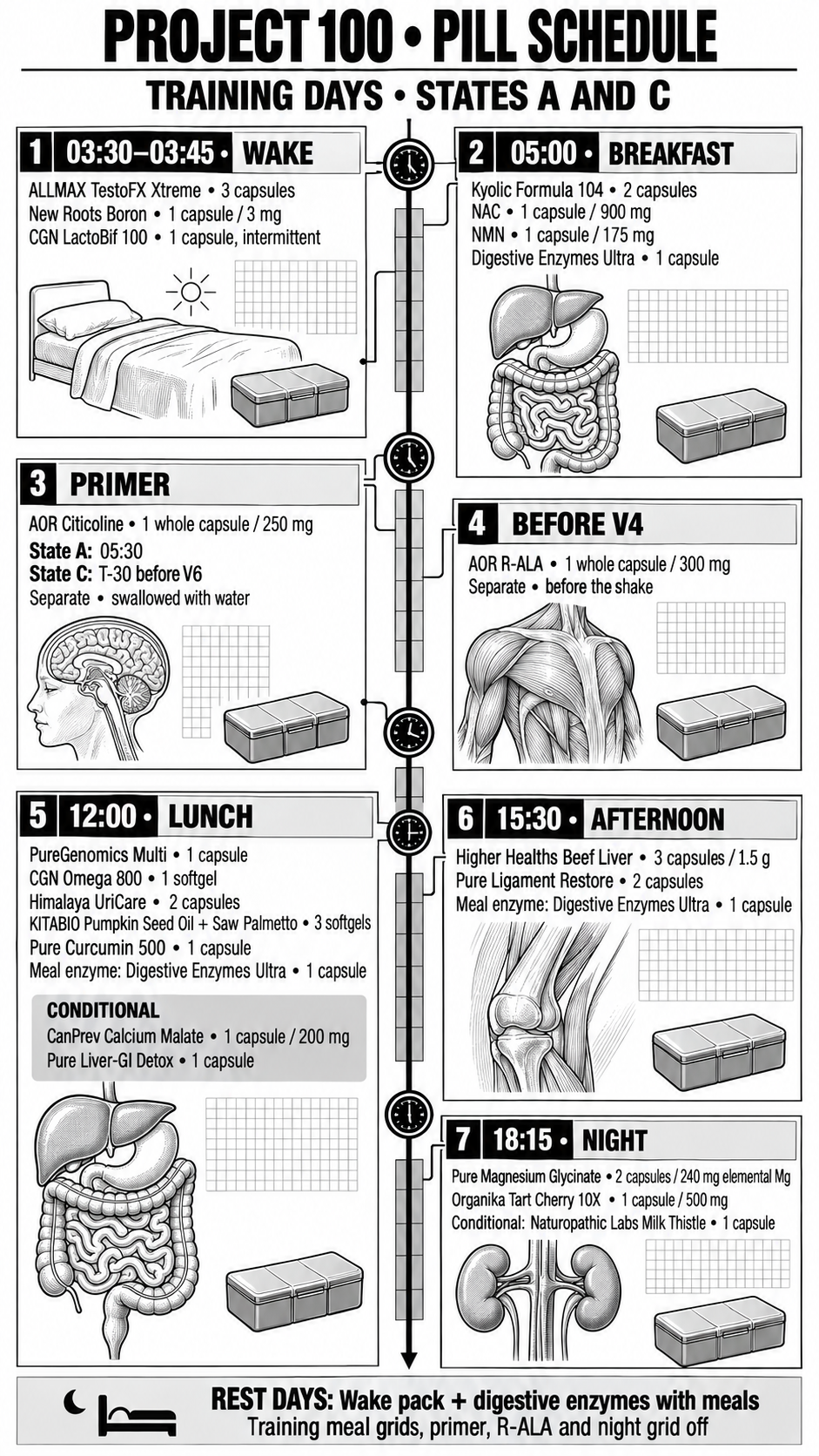
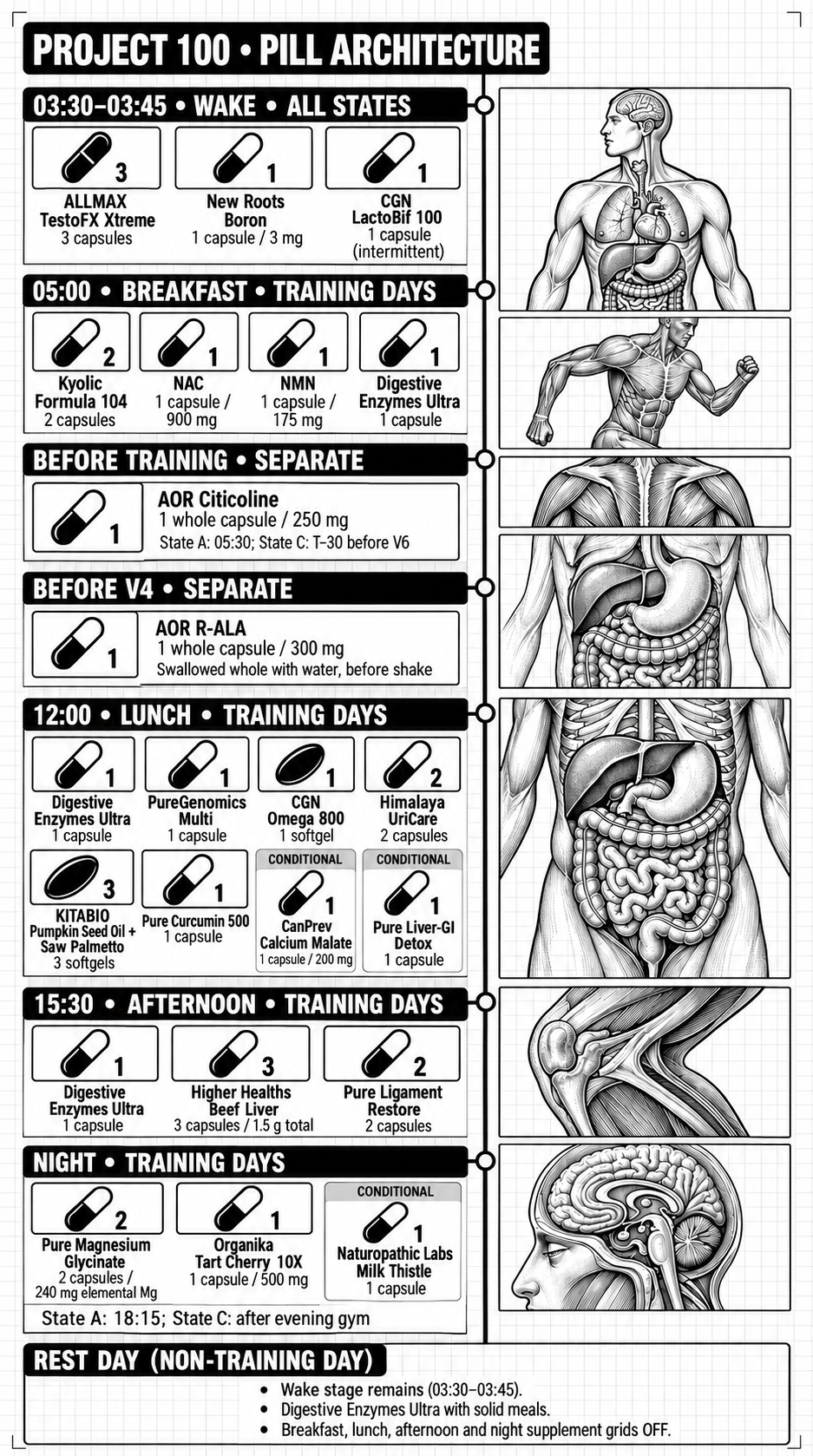
What each of the 17 styles is for J03 Anatomy White anatomy poster with circular ingredient badges. The anatomy is illustration, not a scan.J04 Neon Black panels with cyan rails: quick, high-contrast recipe identification.J05 Console Amber instrument frames and luminous vessels. Liquid colour is a visual treatment, not product colour.J06 Gym blueprint Dark four-step gym order: first V1 or V6, then V2, R-ALA, V4.J07 Mono flow Quiet printable graph-paper reference with clear preparation boundaries.J08 Engineering Tall engineering-style breakdown into ingredients, fluid and separate parts.J09 Clock Circular clock overview of the three day branches A, B and C.J10 Daily console Brushed-metal daily console: full-day boards plus vector and pill-stage cards.J11 Science Muted scientific board. Biology imagery is context, not proof of an outcome.J12 Print plate Printed recipe plate: Formula, Separate and Optional. The master shows six vectors; the cards cover all seven.J13 Pill grid Pill grid: product, count and dose per stage.J14 Crosscheck Liquid stream beside pill stream for one day state.J15 Pill clock Vertical pill clock: the seven stages in order.J16 Grid paper Rounded grid-paper boards built around the right vessel.J17 Architecture Architecture map: what is inside the mixture, what stays outside.J18 Pill plate Quiet light pill-stage plates with conditional tags.J19 White gym White four-step gym sequence with the separate capsule panel.Vector cards in every style → Pill stages → Day branches →
COMPLETE BOOKS · SUPPORTING ANALYSIS
Books & supporting analysis
Guidebook V3.7 The daily routine.
Encyclopedia V3.6 The wider system.
Supporting analysis Methods · Source records · Dated findings. Open the analysis and publication updates →